Archive for the ‘Taoist Philosophy’ Tag

Finding the Way
In part one, I laid out the premise for “energy based” meditation techniques that are the basis of Taoist praxis.
While training with my Sifu, Master Dong, I would notice a certain smile upon his face while doing Qigong. I can only describe the smile as the curious look of someone that has a secret; kind of a “I know something you don’t” grin. The reality is, that his smile is a truthful expression of just that, he does know something most people will never know.
Energy is the treasure we all can obtain, wealth beyond comprehension is always available to you. To the Taoist sages the definition of a rich man is “One who knows when he has enough.” Conversely it might be true to say that a poor man is “One that needs (or simply wants) more.”
Basic human needs not withstanding, the “Realized man” of antiquity was often a hermit living off the land, happy to live in a cave and forage for food, living close to nature. In this light, we can see, that beyond food and shelter, “wealth” is a relative thing. Taoists have no problems with having physical wealth, the defining thing is they don’t need any to be content.
A wise person makes themselves rich with the currency of Heaven and Earth. Gathering that treasure that flows from the Tao; accumulating virtues along the Way is the Taoist Way. Lao Tzu says, “Tao gives and gives and yet it is never depleted.” When you have the Way you, you too will find “The more you give, the more you have.”
Our goal in learning Taoist meditation is to connect directly to energy. Like a pile of gold coins we can sit with our energy or we can “spend” it. Every thought, image, fantasy, illusion, emotion and movement we make takes energy. To the Taoists, purifying this energy was like refining gold. They even called the practice “Spiritual Alchemy.” In meditation then, finding this energy and aligning with it, was and is a divine enterprise.
To the untrained, would be meditator, most attempts end in failure. Even with advanced students it is a difficult skill to master without following certain guidelines. For the beginner, sitting still and attempting to “align with your energy” will guarantee that you cannot. This is akin to a light bulb, that when turned on shines out incoherent light, millions of photons shooting out all willy-nilly, colliding with each other and heading off in random directions dissipating quickly into the surrounding darkness.
You need to train your energy system to focus the energy so it can flow on it’s own. A laser beam is a wave of coherent light that has all the photons aligned with each other, all flowing in the same direction remaining focused and able to travel an almost infinite number of miles without dissipating.
In Part 3 I will describe in detail how we can train our energy to be focused like a laser beam instead of wasting most of it with “incoherent emissions” of Qi.
Previous Lesson Next Lesson
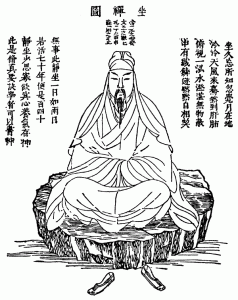
Taoist Sage Sitting With His Treasure
The Taoist methods of meditation differ significantly from other “styles”. To Taoists, the main focus of all the practices, is to understand reality, be content with that understanding, and to change what needs to change to find contentment within the truth of that reality.
This “Taoist” approach revolves around the concept of “energy”.
For example: Understand that everything is made from energy, align yourself with that energy, and the truth will set you free.
This approach is at odds with most other meditation techniques I have encountered. At least one style I know of uses the following type of format.
For example; Imagine you are (fill in the blank), “pretend” you are happy there, “feel good” escaping from reality.
Without attempting to disrespect other methods, I will describe why the Taoist methods are more effective in this article.
The first thing is, Taoists don’t deal with “Illusions“.
Secondly, “feeling happy” can kill you and “feeling un-happy” may save your life.
Thirdly, if you do not “embrace reality” you never have lasting change.
While this all may seem obvious to many it is often subverted by many “meditation” methods in an attempt to “feel good”. The fact is the attempt to feel good is one the paths that have often lead to evil in the world. To be sure making no attempt to “feel” is a Taoist method that is highly effective. By relaxing our practice, we are following the principle of “Wu Wei” or “non-striving” which allows for the spontaneous flow of energy, and this is a basic Taoist tenant.
The end result of “feeling good” comes not from any contrived means but spontaneously after one is aligned with Tao. Therefore, one only needs to align in order to find the truth and be set free from the endless loop of thoughts that plague the human mind.
As simple as that is, most people never find the peace from which they came from, the treasure beyond all treasures that is always within them.
Ineffective mediation techniques often lead to the following:
Stopping extraneous physicality often sends a person’s energy into the mental/emotional realm where an untrained mind will start on a feed back loop, often enhanced by seemingly random images that get projected onto the dark screen of the “Minds Eye”.
Dealing with illusions leads to delusions that take one further away from reality. Evoking thought and emotions waste the energy that could otherwise heal you.
Thinking, feeling, visualizing, triggers emotions that send energy back into the loop of a thinking, feeling, reactive cycle that leads to distraction and rumination and frustration. Often the overwhelmed student gives up leading to resentment that fuels more thinking feeling reacting ad nauseam. The end result is far worse than not “meditating” at all!
In the Part 2, I will explain how we can avoid this type of pitfall, and what makes the Taoist method superior to methods that involve “thinking” or “feeling”.
Next Lesson
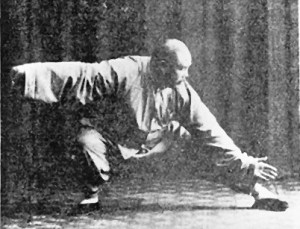
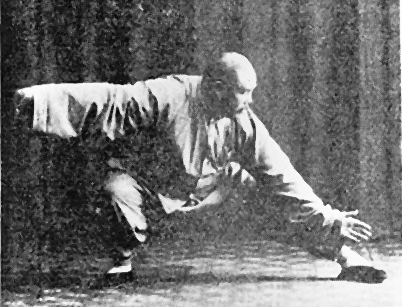
Master Yang Chen Fu
There are so many books…Taoist, Buddhist, Qigong, and Taiji. There have been hundreds of books in my life and it may take me that many years to flesh out this list, but I will do my best!
Since Taiji is a Taoist art I will start with some of the works from the Taoist canon. I list them somewhere between the chronological order that I read them, their historical age, and their relative importance (to me) as it pertains Taiji, Taoism, Buddhism, Qigong, Meditation, Chinese Medicine, and Philosophy, etc.
Books and sets of books:
1. Tao Te Ching (Dao De Jing) by Lao Tzu “The Classic of the Way and it’s Virtues” I have read many translations of this “source book”, my favorites are by Jonathan Star and another by Stephen Mitchell. The Tao Te Ching is full of wisdom in 81 easy to digest verses and it is the second most popular book ever written topped only by The Bible.
2. Chuang-Tzu (Zhuang Tzu) A compendium of stories and fables; a perennial Taoist text. Master Chuang writes in a humorous story style that is compelling.
3. The Art of War (Sun Tzu) Another text over two thousand year old from the Taoist canon. Sun Tzu was a great general and sage, he wrote this famous classic on conflict resolution and strategy that could have been titled “The Art of Achieving Peace”
4. I Ching (The Classic on Changes) Perhaps the oldest book ever written. It was later added to by various sages, in an attempt to understand the nature of “change” and how events must unfold based on the mathematics of their energies and the balance and harmony of the same.
5. The Complete Book of Tai Chi Chuan by Wong Kiew Kit A great book, one of the first ones I read on Taiji.
6. The Tao of Taijiquan by Jou, Tsung Hwa Another great book on the history and philosophy of Taiji as well as an overview of the different forms or “family styles”
7. Tai Chi Chuan Applications by Dr. Yang, Jwing Ming Dr Yang is a prolific writer (I admire his energy!) I have many of his books. This one is the best book I have found describing the applications of Taiji. Written for beginners yet it contains information most advanced Taiji people have never learned.
8. The Taoist Classics (4 volume set) by Thomas Cleary Mr. Cleary s a true genus; translating many books. This set has 15 books in 4 volumes and it was recently released in soft cover. Mr Cleary’s work is sometimes a bit difficult, and I prefer simpler translations, still I highly recommend him because of the large amount of work presented.
Vol. 1 Tao Te Ching; Chuang-Tzu; Wen-Tzu; The Book of Leadership and Strength; and Sex, Health, and Longevity
Vol. 2 Understanding Reality; The Inner Teaching of Taoism; The Book of Balance and Harmony; and Practical Taoism
Vol. 3 Vitality, Energy, Spirit; The secret of the Golden Flower; Immortal Sisters; and Awakening to the Tao
Vol. 4 The Taoist I Ching; and I Ching Mandala
9. Classics of Strategy and Counsel (3 volume set) by Thomas Cleary Another great set, this one contains 12 books. Lots of great philosophy from places as diverse as Greece, China, Japan, The Middle East, Persia, and others.
10. Chronicles of Tao by Deng Ming Dao This is a compelling story, an account of a modern day Taoist’s life. One of the best books I have ever read.
11. Awaken Healing Energy Trough Tao by Mantak Chia I have 8 books by master Chia and while I would say, most are beyond the understanding of beginners, I do recommend this book as an introduction to the “Mantak Chia, Healing Tao approach.” Covers opening the “microcosmic orbit” a basic Taoist technique of meditation.
12. The Roots of Chinese Qigong by Dr. Yang, Jwing Ming I have many of his books. This one is the best book I have found describing the basics of QIgong Written for beginners yet it contains information most advanced people have never learned.
13. Iron Shirt Chi Kung by Mantak Chia Another great and classic book from Master Chia Read the first one first however. This book works with standing postures and will help you get very thorough understanding of advanced Zhan Zhuang I would not attempt to do some of the breathing techniques in these books with out instruction however.
14. Chinese Medical Qigong Therapy by Jerry Alan Johnson This 1100 page book is the most comprehensive book on the subject I have owned it since 2001 and keep reading it and reading it, like many of my books..absolutly huge and definitive this book is a must if you want to “go pro” and get TMI.
15. Cultivating Stillness translated by Eva Wong This is one of those “lost texts” that offers a rare insight into Tao. Written with a slightly Buddhist influence it compels one to contemplate the thinking of the Chinese and their approach to meditation. Also it contains symbolism to help elucidate the reader towards understanding Tao.
16. The Art of Peace by Morihei Ueshiba One of the great masters from Japan; Morihei was the founder of Aikido. Paralleling Taoist thought from a martial artist that was also a pacifist, this book helps define the meaning of life.
17. Tai Chi Explained by Alex Dong Master Alex was the first Taiji master I had, he is the son of my current teacher and the great grandson of Tung Ying Jie, the founder of our lineage. Alex grew up in Hawaii and brings his Chinese history into English for us all. A wonderful and simple book for all Dong practitioners, written by a personal friend of mine. http://www.alexdongtaiji.com/store/
18. Red Book by Tung Ying Jie translated by Alex Dong. A great classic of Taiji finally in English thanks to master Alex. Tung Ying Jie was the primary disciple of Master Yang Chen Fu the inventor of the famous “slow set” Yang style Taiji, the most common exercise practice on the planet. This work has been quoted by many other Taiji Authors but it has never before been available in English; now you can get the “Founders” work! http://www.alexdongtaiji.com/store/
19. Yiquan and the Nature of Energy: The fine art of doing nothing and achieving everything by Fong Ha Master Fong Ha was a student of the great Tung Ying Jie, since then he has branched into a unique method called Yiquan. Master Ha is the worlds foremost authority on this amazing method and he is one of my teachers. Book available here: http://fongha.com/shop/
20. Taoist Health Exercise Book by Da Lia Master Liu published this book in 1974 it is a small and simple primer on Taoist arts. if you can get a copy… someone recently gave me a copy of this older classic work. Pretty cool!
There will be many more soon…patience…
Periodicals:
There are three that I recommend. All are superb,each for a different reason.
1. Qi Journal This excellent magazine is well produced and has very pithy articles about Qigong, Taiji and all things Taoist. Also many books are available through the magazine. You can find it at Borders or Barnes and Noble, or subscribe. This is the best publication for the “Way” and I support it because we have so few available.
2. Tai Chi Magazine Going on 33 years of publication this is the only magazine dedicated to Taijiquan. Another great source for finding books and videos on Taiji. Again this should be available at Borders or Barnes and Noble.
3. The Empty Vessel I love this magazine. Always good stories and articles. Not as fancy as Qi Journal but simply produced and I am sure the traditional Taoists would be proud.
First there was the One, Tao
Then there came the Two, Heaven and Earth,
The Two begets the Third, Heaven, Earth and Humans
In our selves there are three realms that correspond with these “Three”. Consider that we are made from the minerals of the Earth. To that the energy of the Heaven was added in the form of sunlight; we humans are a product of the first two.
Our essences is from the Earth and in a way our bodies come from (and returns to) the Earth…. Our spiritual energy comes from (and returns to) Heaven
Earth is Yin and Heaven is Yang the creative forces of the universe or Tao.
We have Human qualities that we can call mental or thinking processes and we have emotional qualities These two energies make up our “humanness.” We can also call these things Yin/Yang, where our emotions are considered Yin and our thoughts are considered Yang.
The way I see it, the three realms stack up like this:
Our physical self’s being of the Earth (pure Yin)
Our human (mental & emotional) self’s being Yin/Yang
Our spiritual self’s being Heaven (pure Yang)
In a very real way even by “scientific” definition we are created by Heaven (the heavens?) and Earth.
A Classic Taoist Tale
There was a farmer with a beautiful stallion. He was the envy of all his neighbors.
One stormy night, after a barrage of thunder, the farmer awoke to discover that his prize stallion had run off.
The neighbors all said, “How awful; your wonderful horse is gone!”
The farmer casually replied, ” I don’t know”
About a week later, his neighbors were surprised to see that the horse had returned, and with him a new mare.
The neighbors said, “How wonderful; your stallion has returned and he has brought with him a beautiful new mate!”
The Farmer simply said, I don’t know.”
The next week as the farmer’s son was attempting to break in the new mare, he took a fall and broke his arm.
The neighbors exclaimed, “How terrible that your son has broken his arm, and with harvest so soon!”
The farmer merely said, ” I don’t know.”
After yet another week there came to the village a government man. He was on a mission to conscript “all able- bodied men” into the army to guard the country from the invading enemy horde.
The Neighbors happily stated, ” How fantastic that your son’s arm is broken, now he need not go off to war!”
The farmer just said……
“I don’t know.”
The Way
Man follows the way of Nature,
Nature follows the way of Earth,
Earth follows the way of Heaven,
Heaven follows the Way of Tao.
First there was the One, Tao
Then there came the Two, Heaven and Earth,
The Two begets the Third, Heaven, Earth and Humans
From the Three came the ten thousand things…
The Tao contains everything and yet it is nothing…
Always giving, and yet it is never exhausted…
Extending everywhere and yet it is nowhere to be found…
It is the greatest treasure, and at the same time,
It is the simplest of things.
It will never come, and it will never go.
It is the eternal….
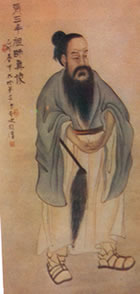



 Taiji on Maui